
Adair County VINELink Release Coverage
Kentucky VINE, short for Victim Information and Notification Everyday, is reached through VINELink. Kentucky describes coverage that includes local jails, adult correctional facilities, mental-health facilities, and certain juvenile records. Adair County Regional Jail participates in the local jail data path. Kentucky DOC institutions also feed the state system, so one person held at the county jail under DOC jurisdiction may have both a local record and a DOC record.
Coverage does not make VINELink a universal locator. A county booking, a state sentence, federal custody, immigration custody, and a confidential juvenile matter follow different systems. VINELink does not replace the Federal Bureau of Prisons locator or an ICE custody inquiry. Juvenile information is restricted even though certain records can participate in notification. A transfer result means the original custodian changed, not that the person returned to the community.
Search an Adair County Inmate on VINELink
A focused search works best with the full name and either the jail ID or DOC number. Kentucky permits a partial-name search, which helps with spelling variants, but broad results require careful identity checks. Use the following sequence for one person rather than treating the results as a countywide release list.
- Open VINELink and choose Kentucky as the state.
- Select “Find an Offender,” then enter a partial or full name, jail ID, or DOC number.
- Compare identifiers and the listed facility before choosing a record.
- Open both local-jail and DOC records if the same person appears twice.
- Read the status and event label exactly. Do not change “transfer” into “released.”
- Save the event date and the time the page was checked for later comparison.
If no match appears, vary the spelling and confirm the number. Then call Adair County Regional Jail and check the court case. A missing VINELink result does not establish release. The person may be in another county, transferred to state or federal custody, held under a different spelling, or outside the public scope of the service. The broader Adair County released inmate search explains how the jail, court, and DOC paths fit together.
What an Adair County VINE Record Shows
Kentucky’s official guidance draws a useful line between in-custody and out-of-custody results. An in-custody result supplies the jail or institution address and telephone number. An out-of-custody result provides the date released. The public result should be read as a status report from its source agency, not as a full release document.
| Field or result | What it can establish |
|---|---|
| Name or offender identifier | Helps distinguish people with similar names and ties the result to a local or DOC record. |
| Custody status | Reports whether the contributing agency shows the person held or out of custody. |
| Facility contact | Identifies the jail or institution to contact when the person is still reported in custody. |
| Release date | Reports the date attached to an out-of-custody event, but not necessarily the exact exit time. |
| Transfer or status change | Shows movement or another update and requires identification of the next custodian. |
VINE may answer when one agency ended custody, yet it may not explain the legal reason. A jail release record can add the timestamp, release type, and receiving agency. An Adair court order can identify bond, dismissal, probation, or another authority. For a state prisoner, DOC Daily Releases and KOOL add release type and supervision context. Pairing these sources avoids treating one brief status as the whole story.
Register for Adair County Release Alerts
Notification registration is separate from the anonymous search. After locating the correct record, select “Notify Me of Status Changes.” Kentucky offers phone, email, text, TTY, and app channels. Choose direct contact details that can receive the message promptly. A switchboard number is a poor fit because automated calls may not reach the registrant.
- Confirm the name, identifier, and facility on the selected record.
- Choose “Notify Me of Status Changes.”
- Select one or more notification methods and enter the requested contact details.
- For a telephone alert, create and retain the four-digit PIN.
- Register on both the local and DOC record if duplicate records exist.
- When a call arrives, enter the PIN to acknowledge it and stop repeats.
Kentucky allows two phone numbers. The Attorney General says county-jail release calls repeat every thirty minutes for up to twenty-four hours or until acknowledged. State-institution notice may begin seventy-two hours before a planned release, while a court discharge, parole change, credit adjustment, or escape can produce less warning. The time a notice arrives is therefore not the physical release time.
Note: Save the alert wording and event date, then verify the event with the agency shown on the record.
How Fast Adair County VINE Updates
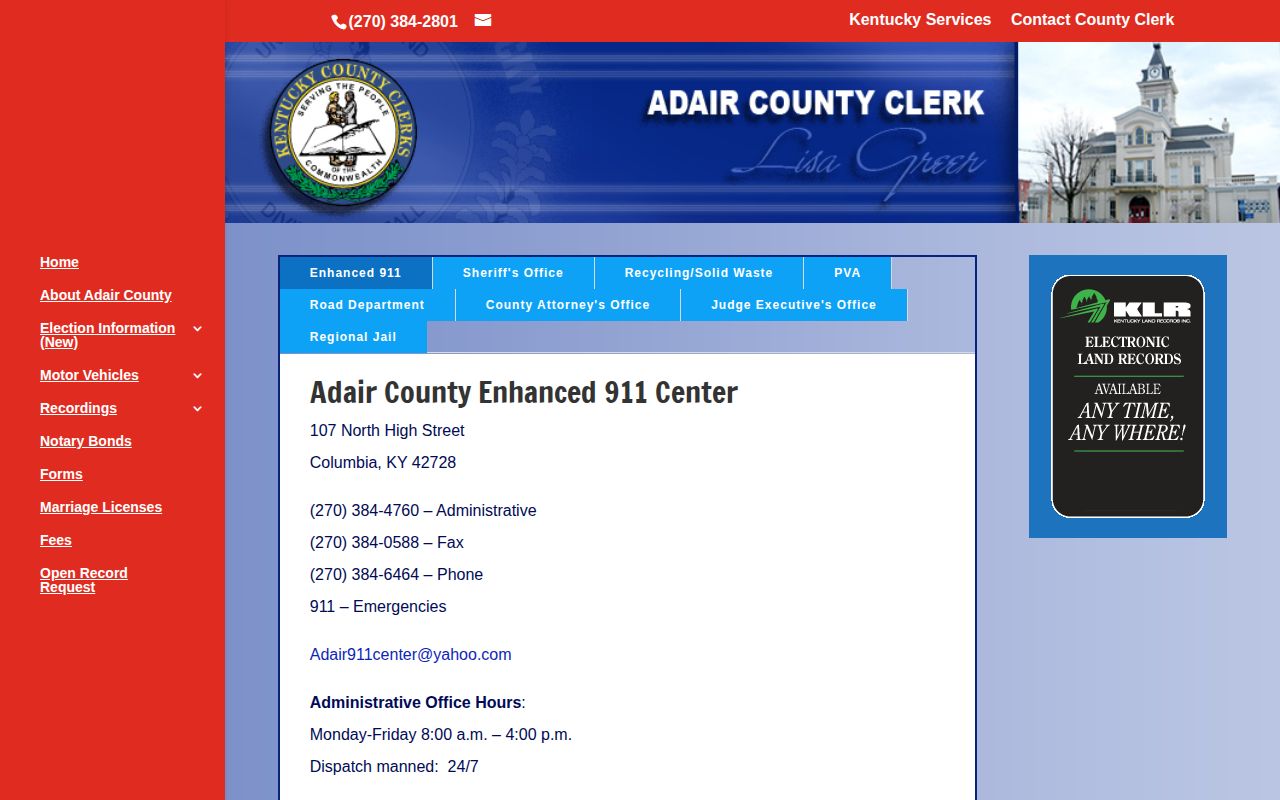
Adair County’s services page says VINE scans local jail booking computers every ten minutes. That is a distinctive local cadence and helps explain why VINE may update more quickly than a court docket. It is a polling statement, however, not a promise that every event will appear publicly within ten minutes. Staff processing, data entry, system errors, and the type of custody event can affect what a user sees.
The official county description of the jail and VINE connection is shown in the captured source below. It documents the two-building jail operation and the local notification link.
Speed also differs by system. KOOL says updates are made daily and warns that information newer than 120 days may not be finalized. A court docket may show an order before or after the physical jail processing ends. For a time-sensitive Adair County release, keep the sources in sequence: VINE for the alert, the jail for the actual endpoint, and the court or DOC record for authority and ongoing status.
Duplicate Adair County and DOC Records
Kentucky warns that a state offender housed at a county jail may have both a local-jail entry and a DOC entry. This is especially relevant in Adair County because the regional jail houses county detainees as well as some state prisoners. Registering only on one entry can miss the next stage. A local transfer alert may record movement out of Adair County Regional Jail while the DOC entry continues to show state custody.
Compare facility, identifier, and status rather than assuming the duplicate is an error. If one record says released and another still shows custody, ask which agency entered each event and at what time. DOC Daily Releases can affirmatively record a state release from Adair County Jail, but it does not include ordinary county bond releases. The jail record remains the direct source for a local booking’s release time and code.
Verify Every Adair County Release Alert
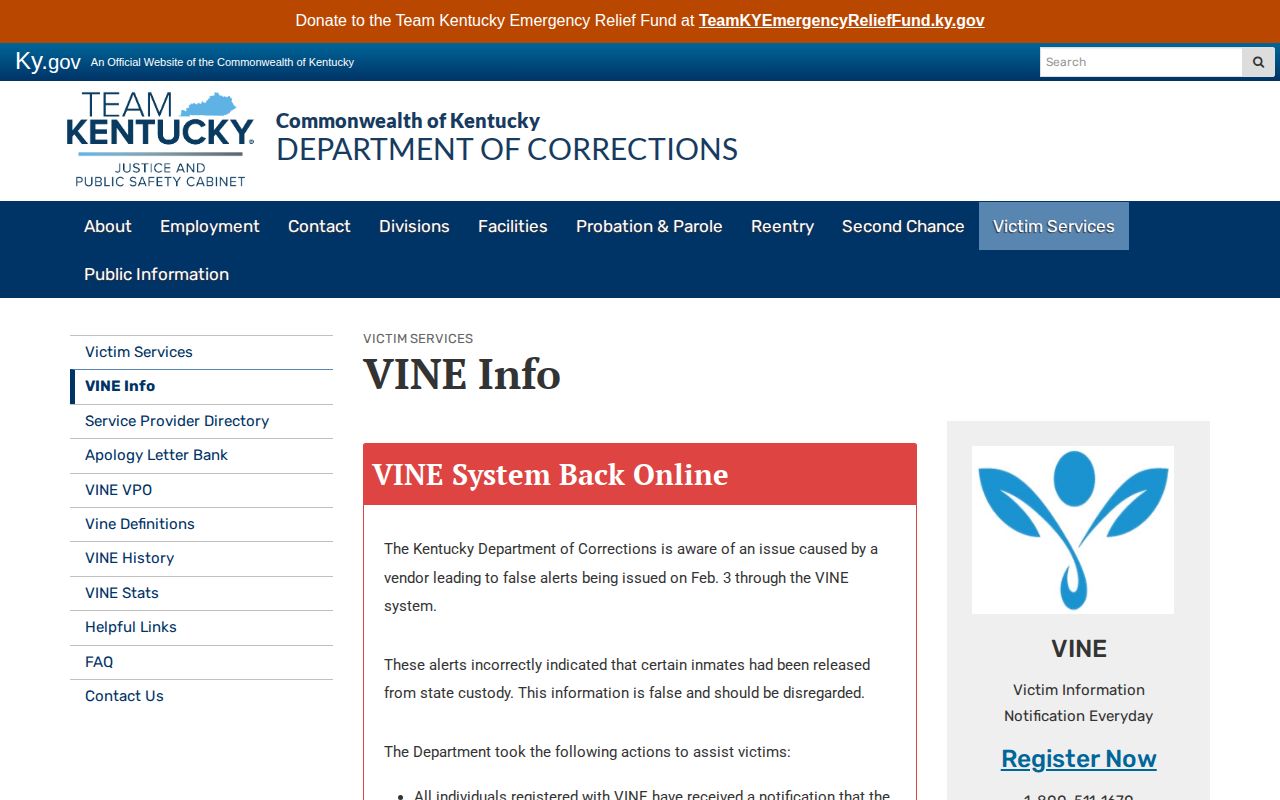
Fast notification and independent confirmation belong together. Kentucky DOC reported that a vendor issue on February 3, 2026 generated false state-custody release alerts and later issued corrected notices. That dated event does not make VINE broadly unreliable. It demonstrates why an automated message should not be treated as a certified release order.
The Kentucky DOC VINE information page documents coverage, registration guidance, and the corrected incident. Its captured view provides official context for the system rather than relying on hearsay about an alert.
A released result confirms only what the contributing record reports. It does not rule out another county case, a detainer, federal custody, immigration custody, or an immediate transfer. Ask whether the event was community release or handoff, and request the receiving agency when the status is unclear.
Adair County Registry Status Is Different
The Kentucky State Police Sex Offender Registry is a specialized compliance source, not a general release database. It can be searched by name, offender number, or geography, including Adair County. Registration information may enter through DOC before prison release or through Probation and Parole as supervision begins. A listing reflects a registration duty and current registry data, not the person’s complete custody history or exact release moment.
Likewise, a “noncompliant” registry label should not be translated into a new custody conclusion. Use VINE for the reported custody event, KOOL for DOC supervision status, and the court or law-enforcement record for any new legal action. Keeping those systems separate protects against a confident but unsupported claim. Lifetime registrants are checked more often than people in the ten-year or twenty-year categories, but that compliance schedule still says nothing by itself about a new jail event. Read each portal for the narrow fact it was designed to report.
Reconcile an Adair County VINE Result
When sources disagree, compare the event each source records rather than choosing the newest screen without context. If the Adair current list drops a name, VINE reports release, and CourtNet shows a bond order, the careful conclusion is that VINE reports a custody release on its stated date and the court supplies a likely legal basis. The jail’s own timestamped release record remains the best source for the exact time and local release code. A news report about the earlier arrest proves only that the person was lodged.
A different result follows if VINE says transfer. Ask Adair County Regional Jail for the receiving agency. If KOOL then lists a state institution, the evidence supports movement into Kentucky DOC custody, not community release. For a DOC prisoner, an actual entry in Daily Releases is stronger evidence of an executed state event than a future KOOL date. The file can identify the release type and the facility released from, while KOOL may update later with parole, mandatory reentry supervision, discharge, absconding, or another location.
Keep a simple evidence log with the name searched, identifiers used, record selected, exact event wording, facility, event date, and access time. That record helps the jail, court clerk, or DOC records staff resolve a conflict without relying on memory. It also prevents a later status update from being mistaken for what the system displayed when the alert first arrived.